




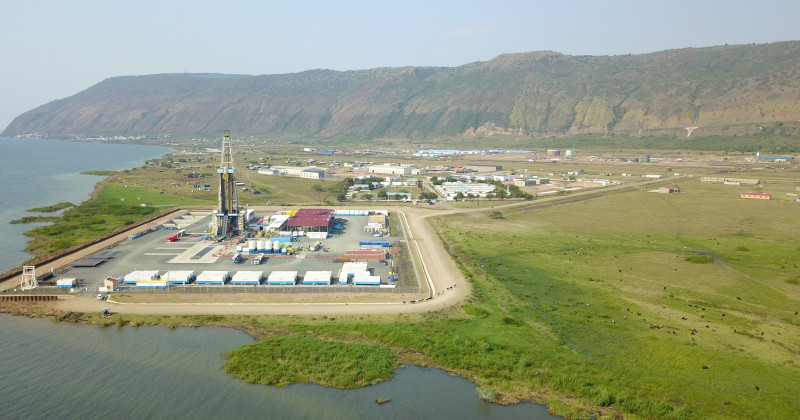
The ambitious development of the Lake Albert oil resources and the accompanying East African Crude Oil Pipeline (EACOP) has entered a critical phase as operators TotalEnergies and CNOOC move to balance industrial scale with stringent environmental and social safeguards.
With reserves estimated at over one billion barrels, the projects, comprising the Tilenga and Kingfisher fields, represent a cornerstone of Uganda’s economic diversification strategy, yet their location within ecologically sensitive zones has placed them under intense international scrutiny.
The project is marked by significant technical complexity and a large logistical scale. It involves drilling approximately 400 wells and constructing a 1,443-kilometer buried heated pipeline to the Tanzanian port of Tanga. Unlike traditional extraction methods that are often deemed “dirty,” the Tilenga and EACOP projects aim to be low-emission benchmarks. They target Scope 1 and 2 emissions of 13 kg CO₂e per barrel of oil equivalent (boe), which is considerably lower than the industry average of 19 kg CO₂e per boe for similar global projects. This achievement is possible due to the reinjection of produced water and the use of solar power at the pumping stations.
Social license to operate remains the primary focus for the consortium, given that the projects require the acquisition of 6,400 hectares of land. This process affects over 19,000 stakeholders and necessitates the relocation of 767 primary residences. TotalEnergies has committed to a land acquisition program aligned with International Finance Corporation (IFC) standards, offering affected families a choice between monetary compensation or new housing. The operator has emphasised that over 20,000 consultative meetings have been held to date, underscoring a commitment to transparency in a region where land rights are a sensitive flashpoint.
“The Tilenga and EACOP projects are situated in a sensitive social and environmental context and require land acquisition programs with close attention to the rights of the affected communities,” the company noted in its latest strategic review. This stance is coupled with a “Net Positive” biodiversity mandate, which includes supporting the Uganda Wildlife Authority in rhino reintroduction programs and collaborating with the IUCN to protect chimpanzee habitats. Within Murchison Falls Park, the project footprint has been strictly limited to less than 0.03% of the surface area to mitigate interference with the local tourism economy.
As production nears, the success of the Lake Albert development will likely be judged by its ability to catalyse the Ugandan and Tanzanian grids without compromising the delicate Rift Valley ecosystem. By exporting surplus electricity from the Kasenyi treatment plant back into the national grid, the project aims to provide a dual benefit of hydrocarbon revenue and improved energy security. For the Business Times reader, the Lake Albert projects represent a high-stakes litmus test for whether “frontier oil” can truly coexist with modern Environmental, Social, and Governance (ESG) mandates.